Your Pittsburgh IT company has never been to a job site
Your IT company has never seen one of your job sites.
They know the office. They've never stood in the trailer at 6 a.m. while the super can't open today's drawing set and nine guys are on the clock watching him hit refresh.
That's not a support ticket. That's payroll burning while somebody at a desk downtown tells you to try again in a minute.
Pittsburgh has plenty of MSPs. Most of them stop at the office door.
The MSPs around here got built for law firms, medical offices, and accounting practices. One location. Everybody at a desk. The network looks the same in December as it did in March.
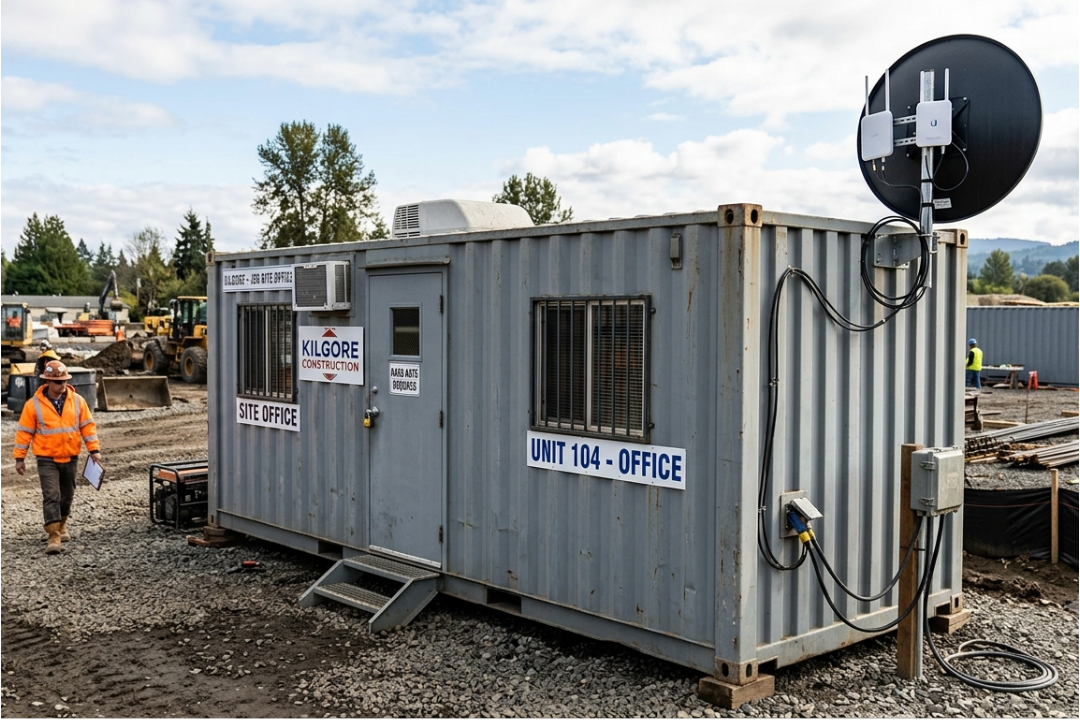
Your business doesn't work that way. You've got an office in Robinson or Cranberry or wherever the estimators sit, four active sites, a trailer that moves twice a year, tablets riding around in trucks, and a foreman who needs a drawing set to load over whatever signal exists at that address.
So what happens when you call? They remote into a laptop they can see, find nothing wrong with it, tell you it's a connectivity issue, and close the ticket. They're not lying to you. They just can't see the half of your business where the money gets made.
That gap is why I built Don's Tech Rescue around contractors instead of taking whoever calls.
What managed IT actually has to cover for a contractor
If you're shopping for managed IT around Pittsburgh, this is the scope that has to be in it. Anything less and you're paying for half a service.
Run the office stack, meaning Microsoft 365, email, file access, the accounting workstations, servers and a helpdesk your admin staff will actually call twice.
Get real bandwidth to the site and design the coverage for it, because upload speed is what kills drawing sync, not download.
Manage every device that leaves the building, enrolled before it ships out, encrypted, remote security, and replaceable the week it goes off a scissor lift.
Protect the data your bids and contracts live in, with a backup somebody has tested by actually restoring it.
Keep the evidence, so when a general contractor's compliance officer asks what your controls are, there's a document instead of a phone call to somebody's nephew.
Notice what drives that list. It isn't a product catalog. It's the fact that your work happens in two places at once and most support models only cover one of them.
The DoD piece nobody local is set up for
If you touch work on military installations, USACE, or NAVFAC projects, this part matters more than the rest of the post.
Your prime is passing security requirements down to you. That's FAR 52.204-21 in the subcontract, with CMMC Level 1 riding on top of it, and under 32 CFR 170.23 it reaches subcontractors at every tier. Being a sub to a sub doesn't get you out of it.
Level 1 is 15 requirements and every one of them has to be MET. No partial credit, no plan to fix it later. You self-assess, you affirm it, and the award depends on the answer.
One correction while I'm here, because bad advice travels fast in this trade. CMMC applies to DoD contracts and subcontracts only. A VA hospital, a GSA building, or a federally funded highway job is not DoD work and CMMC doesn't apply to it. 32 CFR 170.3 is where that line gets drawn. Anybody telling a paving contractor he needs CMMC for a PennDOT job is guessing.
The Pittsburgh District is USACE. This is live in this market right now, and no generalist MSP in the region is positioned on it.
Onsite is the part you can't buy remotely
Don's Tech Rescue runs out of Beaver County, which puts Pittsburgh, Moon, Coraopolis, Sewickley, Cranberry, and most of the sites in between inside an easy drive.
That's deliberate. You can't design site coverage from a spreadsheet, and you can't work out why the trailer drops every afternoon at 3 without standing there while it does it. The Foundation tier includes 7x5 onsite and helpdesk support for exactly that reason. Framework adds 24x7 automated security monitoring on top of it, so the alerting keeps running after everyone goes home.
Somebody who knows your setup answers when you call. Whoever scopes your systems is whoever works on them.
Questions I get on the first call
Do you actually come out, or is it all remote?
I come out. Office and site both. Most of what's wrong with a contractor's technology is obvious in twenty minutes of walking around and invisible from a remote session.
What if I already have an IT guy?
Keep him if he's good. Plenty of shops need somebody to own the job site connectivity and the field devices while the office stays where it is. I'll tell you straight if what you already have is working.
Do you only work with DoD contractors?
No. Commercial GCs and specialty subs with no DoD exposure are a normal fit. Compliance is what a lot of contractors come in the door for. Keeping crews working is what they stay for.
What happens on a discovery call?
You talk, I listen. I ask what broke last month, how many sites are running, and what your GCs have started asking you for. If Don's Tech Rescue isn't the right fit, I'll say so on the call instead of sending you a proposal.
I'd rather walk your office and one of your sites and tell you what I find than sell you anything off a website. Here's who you'd be dealing with if you want to read up first.